
The Brow Removal & Correction Journey — What to Expect, Start to Finish
The Brow Removal & Correction Journey: How We Guide You From First Photo to Finished Brows
Fixing brows that went wrong isn't one appointment — it's a guided process. Here's exactly what that process looks like: how we assess, how we choose your path, how your skin sets the pace, and how we design the brows you actually wanted. Start to finish, together.
A 14-minute read — or jump straight to your stage below
Microblading removal is a staged process — typically 4–8 sessions (occasionally up to 10) of saline and/or PICO laser removal, spaced 4+ weeks apart, over many months — followed by color correction and a conservative rebuild of your new brows. At Le Kitsuné in Manhattan, one artist guides the entire journey: assessment, removal, redesign, rebuild, and maintenance. Removal sessions are $450; complete journeys typically run $1,700–$4,250+ depending on saturation. Free video consultations available.
Navigate This Guide
Almost every brow is fixable. Gray, orange, blocky, blurred, wrong shape — about 30% of everything we do is correcting work from other studios. We see your exact situation every week.
It's a journey, not an appointment. Most removal plans take 4–8 sessions over many months — a few finish sooner, complex cases run to 10. Your body's response is the biggest variable — so the plan adapts as we learn your skin.
You never decide alone. We place you on our Reset Spectrum at your free consult — three ways forward, chosen together in plain language. Then we adjust as your skin shows us what it prefers.
One artist, start to finish. Saline, PICO laser, color correction, and your new brow design — one roof, one plan. The person clearing your old pigment is the person designing what replaces it.
You're Not Stuck With Them
You trusted someone with your face, and it didn't go the way it should have. Maybe it happened last week and you're still in shock. Maybe it happened years ago, and the color has slowly drifted somewhere you never agreed to.
Either way — take a breath. Your brows are fixable. And you don't have to figure out how alone.
This guide walks you through the entire journey — every stage, every decision, every honest timeline.
Correction isn't a side service here. It's a specialty. Roughly 30% of our work is fixing brows done at other studios — which means Renee has seen your gray tint, your orange shift, your blocky saturation, your "one brow sits higher," thousands of times, on every skin type and every skin tone. What follows is exactly how we guide clients from a panicked first photo to brows that finally feel like theirs.
Not a sales pitch. A map.
"I Just Got Them and I Hate Them" — Read This First
If your brows are days old and you're spiraling — you feel like you have two dark slugs on your face, you look angry in every mirror, you're googling at midnight — you are living the single most common panic in permanent makeup.
We know, because we hear this exact story every week. So here's what we tell every one of those clients.
Is what I'm seeing the final result?
No. What you see today is not what you'll see in a month. Fresh pigment sits bold on top of the skin and typically softens 40–50% over the next two to four weeks as it settles and your skin cycles. Brows that feel shocking on day one are often unrecognizable — in a good way — by week three.
Some of what's terrifying you right now may simply be healing.
So should I just wait it out alone?
"It might be healing" doesn't mean sit with the dread. An experienced correction artist can look at a photo and tell you in minutes whether you're on a normal healing track — or whether what you're seeing needs a plan.
That's exactly what our free video consultation is for. Send photos today. Get a real answer instead of two more weeks of guessing.
What should I absolutely NOT do right now?
Don't take matters into your own hands. No salt scrubbing. No exfoliants. No picking. No DIY removal kits from the internet.
None of it fades pigment safely — it irritates healing skin, pulls pigment out unevenly, risks scarring, and makes professional correction longer and more expensive. Keep the area clean. Keep it moisturized. Keep your hands off. And get expert eyes on it fast.
You may be searching "emergency microblading removal" right now — and we understand the urgency completely. Here's our honest position: the first days after a procedure are a delicate window, and the right move depends entirely on what was done and how your skin is healing. Send us photos and we'll tell you the truth about your options. What we won't do is rush you into something that trades how you look years from now for how you look this week. We fix brows the right way — managed so you look as good as possible, as fast as possible, without ever sacrificing the finish line.
Most correction clients walk in embarrassed — like they should have known better, chosen differently, researched more. Here's the truth: you trusted a professional, and that trust was let down. That's not on you. We fix work from other studios every single week. You're not the cautionary tale. You're the kind of client we know best.
"These are very common now — I want you to know you're not alone."
— Renee, in a recent removal consultation"She literally saved my terrible, overplucked, poorly microbladed brows."
— Caitlin F. · Le Kitsuné ClientStage One: The First Conversation — Where You Stop Navigating This Alone
Every journey here starts the same way: a free 10-minute video consultation. No fee. No pressure. No obligation.
You send photos. We talk. You leave with a plan.
What happens on the call?
Renee starts by listening — not diagnosing. Before she says a word about solutions, she wants your story: what was done, where, when, how many rounds, what you hate most when you look in the mirror, and what you're hoping for now.
That story matters. Two people with identical-looking brows can need completely different plans, depending on the history underneath.
What is Renee actually reading in my photos?
Four things — and each one shapes your plan.
Your pigment. The current color, the undertone hiding underneath it, how saturated it is, how deep it sits. This predicts how it will respond to saline versus laser — and whether laser could push it through a warm stage first.
Your shape. How much of the existing brow falls outside the shape she'd design for your bone structure. Sometimes everything has to go. Often, only parts do.
Your skin and history. Thickness, sensitivity, scarring, retinol and acid use, Botox, pregnancy or nursing, sun habits — anything that changes how you heal or what we can safely do right now.
Your calendar. Weddings. Surgery. Travel. Beach season. Removal is a months-long arc, and we plan it around your life — not the other way around.
What do I walk away with?
A real plan — not a pitch. Your realistic options. Roughly how many sessions each involves. What it costs, what it feels like, what you'll look like along the way. If we can start in-studio the same day as your first appointment, we often do.
And if the honest answer is "wait" — or "this only needs one small correction" — you'll hear that, too.
Three photos in natural light, no brow makeup: one straight on, one from each side so we can see both tails. That's all we need to give you a meaningful assessment before you ever set foot in the studio — and you can add them right to your consultation request.
"The good news is color is very corrigible — it's the shape that is not. Thirty percent of my book is corrections or removals, so this is very normal. You're on par."
— Renee, in a recent removal consultationEvery method, every timeline, and the science behind them — the companion deep-dive to this journey.
Stage Two: The Reset Spectrum — Three Ways Forward, Chosen Together
Here's the part most people don't expect: you don't have to choose. Saline or laser, correction or removal — you don't need to become an expert in any of it. That's our job — and the answer is often “both.”
At your consult, we place you on our Reset Spectrum — three ways forward, laid out in plain language: what each costs in time, money, and discomfort. We decide together. Then we adapt as your skin shows us what it prefers.
The Reset Spectrum runs from a Full Reset (remove first, rebuild after) to a Targeted Reset (remove only what falls outside your future shape) to a Color Reset (correct in place — no removal at all). Every correction case we see lands somewhere on it.
Correcting on top of dense pigment only compounds the problem — like drawing hair strokes over a filled-in pen mark. So we fade the old work first, over multiple sessions, until there's breathing room in the skin for a natural rebuild. It's the longest road — and where patience pays off most dramatically.
The most common reset — and the one nobody tells you exists. We remove only what falls outside your ideal future shape. Less removal. Fewer sessions. Faster finish. Some studios call this “brow lightening” — fading just enough to design over. This is where removal stops being demolition and becomes design.
We neutralize the unwanted undertone with carefully chosen counter-tones, then layer in your target color. We watch how it heals. We only escalate if your skin tells us to.
Every choice about which pigment to lift — and which to leave — is really a choice about the brow you'll wear for years. This is why the person doing your removal should be the person designing your new brows. When removal happens at one studio and new brows at another, that connection is lost. Here, it never is.
"You have two options for removal — saline and laser. They're interchangeable. They're symbiotic. They help each other. You don't have to commit to one over the other."
— Renee, in a recent removal consultationStage Three: The Removal Loop — Where We Learn Your Skin
Removal isn't one magic appointment. It's a loop: treat → heal → reassess → adapt.
Each cycle takes about a month. Each session lifts a percentage of the pigment — never all of it at once. And each round teaches us exactly how your body clears pigment.
That knowledge is what makes session three smarter than session one.
Why do we usually start with saline?
Saline removal implants a sterile, high-salt solution into the skin; through osmosis, it draws pigment up to the surface, where it lifts away naturally as the skin heals. We reach for it first for four reasons:
It's precise. We can treat a heavy tail or a boxed front without touching anything else. It's predictable. Pigment fades evenly — no color surprises. It works on every pigment color — including pigment a previous laser elsewhere already pushed warm. And it's gentle on your brow hair. Saline doesn't damage hair follicles — which matters more than most studios ever mention.
A session runs about 20–30 minutes after numbing.
When does PICO laser join the plan?
When density calls for it. For heavy overall saturation, our PICO laser — performed in our NYC studio under medical supervision — reduces density faster than saline alone. Ultra-short pulses shatter pigment into fragments your immune system clears out. The laser itself takes about five minutes, and because PICO works through energy distribution rather than heat, it's gentle enough for all skin tones. That matters more than most pages admit: older heat-based lasers carry a real risk of lightening or darkening the surrounding skin on deeper complexions. PICO's energy-distribution approach — plus a spot test before every first laser session — is how we protect every skin tone we work on.
And this is an and/or decision — never either/or. We regularly use both on the same brows: saline first, to de-saturate and show us how your skin behaves; laser after, to clear what remains. Choosing the tool, the sequence, and the moment to switch is our job — you never have to pick.
Saline vs. PICO laser at a glance
| Saline Removal | PICO Laser | |
|---|---|---|
| How it works | Hypertonic solution lifts pigment up and out through the skin's surface | Ultra-short energy pulses shatter pigment; your immune system clears it |
| Session time | 20–30 minutes after numbing | About 5 minutes |
| Precision | Zone-by-zone — can target a single tail or stroke | Treats the area broadly; best for overall density |
| Color risk | None — fades evenly, no color change | Can shift warm (pink → orange → yellow); we spot-test first |
| Your natural hair | Doesn't damage follicles | Can reduce hair density in some cases |
| Best for | Targeted plans, all pigment colors, prior failed laser | Heavy saturation; speeding up cleared canvases |
| Price | $450 per session | $450 per session — same price, so it's never a sales decision |
Why do brows sometimes turn pink or orange during laser removal?
Because pigment doesn't fade in a straight line — and we'll never let it surprise you. Many cosmetic pigments contain iron oxides and titanium dioxide, and laser energy can shift them: sometimes darker at first, then through warm stages — gray → pink → orange → yellow — as the components break down at different rates.
If nobody warned you, this looks like disaster. In reality, the dermatology literature describes it as part of the elimination process, not a complication. The pigment breaking down on schedule.
That's exactly why we do a complimentary spot test on a small area before ever committing your full brow to laser. We test first. We plan conservatively. You'll never be caught off guard mid-journey.
How many sessions will I actually need?
Here's the honest answer nobody else gives: no one can promise you a number — and you should be suspicious of anyone who does. Even the peer-reviewed clinical tool for predicting tattoo-removal sessions — the Kirby-Desai scale, which scores skin type, location, color, ink density, scarring, and layering — only loosely predicted real outcomes, and the tattoos it studied needed anywhere from a few sessions to many.
Pigment load. Depth. Skin oiliness. Immune response. Your skin writes the schedule — we just read it.
"I like to be very transparent: it takes a long time, and everybody responds differently — we won't really know how it goes until it happens. Will this eradicate it? Yes. How many sessions will it take? It could be anywhere from four to ten. I've done as many as ten for a client, and as little as three for complete removal."
— Renee, in a recent removal consultationWhat we can promise: honest estimates up front, a real reassessment after every heal, and one piece of genuinely good news — facial skin, with its rich blood and lymphatic flow, clears pigment faster than almost anywhere else on the body. Brows are on your side.
Does removal hurt?
You'll be comfortable the whole way. Two-stage professional numbing before every session. Technique adapted for thin or sensitive skin. Constant check-ins — Renee paces every session to your tolerance, not a clock.
Most clients describe saline as moderate pressure and laser as quick snapping. Nobody white-knuckles it here.
The first session isn't just treatment — it's information. How much lifted? How did you heal? Did the undertone shift? Your skin's answers rewrite the plan in real time: which zones get treated next, whether laser joins in, when the canvas is ready. This is what "we figure out your skin together" actually means — and it's why cookie-cutter session packages sold upfront should make you suspicious anywhere.
Will I Be Without Brows? Living Your Life During Removal
The question underneath every removal consult — even when it goes unasked: what will I look like while this is happening?
Fair question. Honest answer.
What will I look like between sessions?
You will not be browless. Let's just say that first, because it's the fear underneath everything.
On targeted plans, most of your brow stays intact the whole time — we're only clearing what won't be part of the new design. Even on full-removal plans, pigment fades gradually across sessions rather than vanishing overnight. And once each session's short healing window closes, brow makeup covers the in-between beautifully.
Between sessions, most clients look completely normal to everyone but themselves.
What does healing after each session involve?
A few days of redness. Possibly light scabbing or flaking that sheds within one to two weeks. Then quiet skin until your next visit.
For saline sessions, we'll walk you through simple aftercare — keeping the area clean and lightly moisturized so the scab can carry pigment out undisturbed.
During each healing window: no picking — ever. The scab carries pigment out with it; pick it, and you keep the pigment and risk a scar. No makeup directly on the area for the first several days. No heavy sweating, saunas, or swimming for about a week. Pause retinoids and acids for roughly two weeks around each session. And SPF is non-negotiable — sun inflames healing skin and can shift the very pigment we're trying to remove.
How do we plan around weddings, trips, and big moments?
We plan around your calendar — not ours. Wedding in June? Beach house every August? Surgery on the books? Tell us in the first conversation. We map sessions so visible healing never collides with the moments that matter — sometimes that means starting sooner than you expected, sometimes pausing over a season.
"I like to be a realist. Everybody's working, everybody's busy, you have lives — so I always say, do what you need to do. I have clients who say, 'I'm going to a gala tomorrow,' 'I'm traveling,' 'I have client-facing meetings.' Do what you need to do."
— Renee, in a recent removal consultationHats and big sunglasses are your best friends during the flaky days. And after every single session, we'll tell you exactly when makeup is safe again.
This is what concierge care means in practice: you always know what tomorrow looks like.
UV worsens inflammation, slows healing, and can alter pigment mid-journey. During a staged removal plan, daily SPF over the healed area, hats, and sunglasses aren't cosmetic advice — they're part of the treatment.
Stage Four: The Redesign — Your New Brows Take Shape Before the Old Ones Are Gone
Here's what makes this a journey with a destination — not just a demolition: while your skin is clearing, Renee is already designing.
Every reassessment isn't just "how much pigment lifted." It's "how close is this canvas to ready — and what will we build on it."
How is my new shape designed?
From your bone structure — not from a trend, and not from your old brows. Your new shape is built from your brow bone, your eye spacing, how your face moves when you speak, and where your natural hair actually grows. Not a stencil. Not the shape the last artist imposed.
And not forced mirror-image symmetry, either. Faces are naturally asymmetrical, and great brows are sisters, not twins — balanced to read as harmony, adjusted independently side to side.
"Your bone structure is my map."
— The Le Kitsuné Studio PhilosophyWhat if I want changes to the design?
Then we change it — as many times as it takes. Before pigment touches your skin, the full design is drawn on in pencil, so you can see the shape on your actual face, in real light. Tail shorter? Arch softer? A hair more width in the front? We adjust in real time.
Nothing proceeds until you're 100% confident. After what you've been through, that's not a courtesy. That's the whole point.
What does the rebuild itself look like?
Neutralize first. Then build — conservatively. If any residual undertone remains, we cancel it with color theory so it can never ghost through your new color. Then we build with our hybrid machine technique — fine nano hair strokes for realism, soft powder shading for dimension — deliberately starting lighter than you might expect.
Everyone's skin takes pigment differently. After a removal journey, yours has told us plenty — and we honor that by layering like a painting. We can always add more. We can never easily take away.
About a month later, once your skin has fully cycled, your touch-up locks in the dimension, deepens color where you want it, and perfects the edges. That second session is where "good" becomes "exactly right."
How do I make sure I never go through this again?
Your new brows are built with an exit strategy. Pigments chosen to fade gracefully instead of turning inky or neon. Densities that can be softened later if your style changes. Shapes that still make sense as your face evolves.
Then light maintenance every 6–8 months keeps everything current — small course-corrections forever, instead of another big removal ever.
Your old brows were a decision made once and locked in. Your new brows are a relationship — managed over time by someone who knows exactly how your skin behaves. Because we learned it together, session by session.
The CraftBone structure, balance, and the collaborative preview process behind every shape we build.
Our PhilosophyThe conservative method that prevents the very problems you're here to fix.
One Artist, One Plan, Start to Finish — Why It Matters
In most of the industry, this journey is split across strangers. Laser clinics remove pigment but don't design brows. Many brow studios don't remove at all — they refer you out to a third-party laser tech, wait six to eight weeks, and hope the canvas comes back workable. Laser-only chains dismiss saline; saline-only studios can't offer laser.
At every handoff, the thing that matters most gets lost: the connection between what's being removed and what's being built.
At Le Kitsuné, saline, PICO laser, color correction, and your new brow design all live with one artist, in one plan, under one roof — laser under medical supervision, in our Manhattan studio. The same eyes that watched your skin respond to session one are the eyes mapping your final shape. Every removal decision is made because of the design it's clearing space for.
After 15,000+ procedures — and a calendar that's roughly one-third corrections — there is no version of your situation Renee hasn't guided someone through. Every skin type. Every pigment. Every "I was told this was unfixable."
We manage the whole arc so you look as good as possible, as fast as possible — but never at the cost of the years after. And when the rebuild is done, the relationship isn't. We'll be your brow partners at every 6–8 month touch-up, through every color adjustment as your style evolves, for as long as you'll have us.
We're not here for one appointment. We're here for every version of your brows — through the removal, through the rebuild, and through every year after.
How Long Does It Take — and What Does It Cost?
Every correction is different. But after thousands of them, journeys cluster into three honest tiers.
Best for: shape mostly workable, color close-ish — no removal needed. We neutralize and correct the color inside your rebuild appointments. Typical total: ~$1,700 — the $1,550 rebuild plus a one-time $150 color correction.
Best for: some zones too saturated to correct over; undertone needs neutralizing. One to three targeted removal sessions, reassess, then rebuild. Typical total: ~$2,900 — three removal sessions ($1,350) plus the $1,550 rebuild.
Best for: dense, blocky pigment or a fundamentally wrong shape. Multiple removal rounds until the canvas has real breathing room, then a full rebuild. Typical total: $4,250+.
The longest road. And consistently our most dramatic transformations.
"It's a long game, and it will require some patience. I just finished a client who did a combination of laser and saline removals for about a year and a half — and we just finished her new brows. She's super happy."
— Renee, in a recent removal consultationFirst session to final result — swipe each journey to see every stage

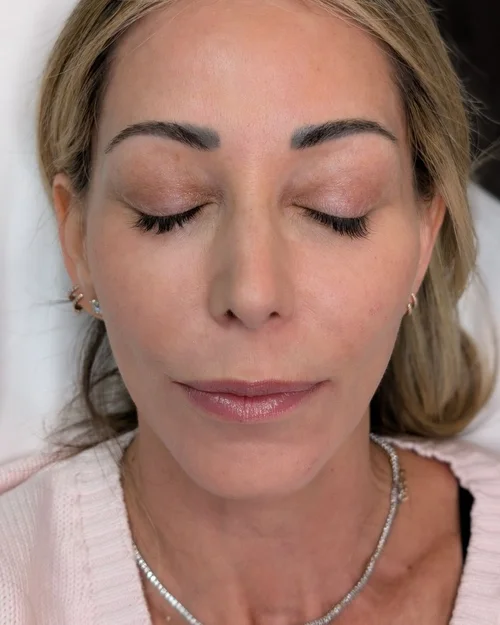
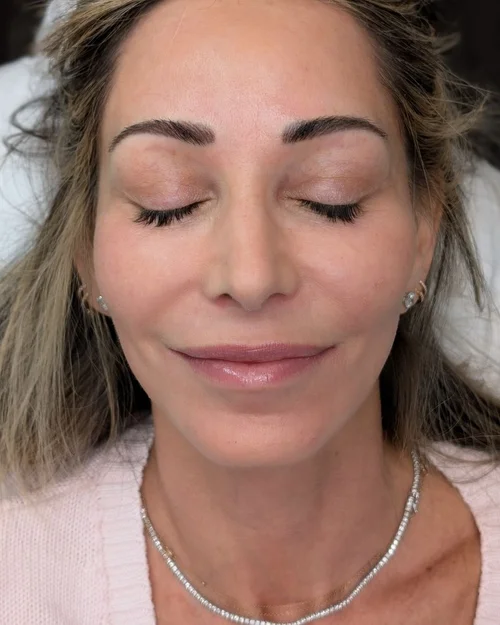
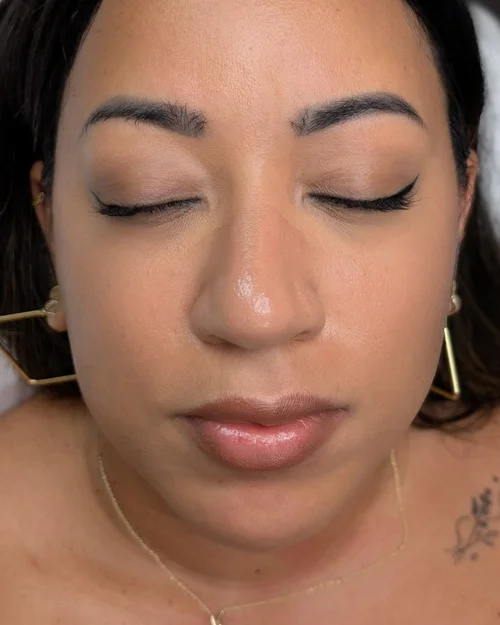

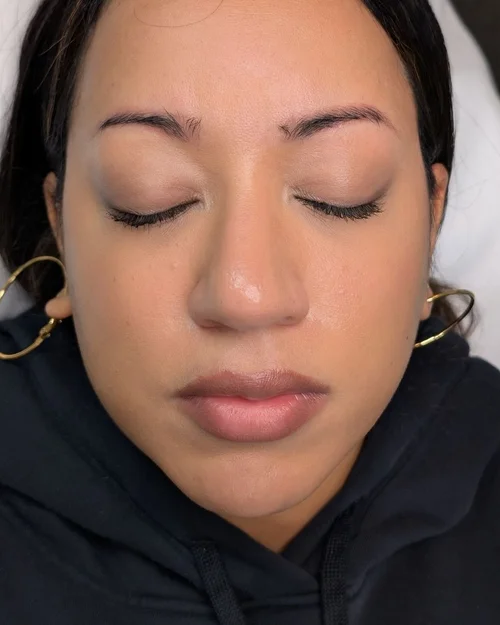

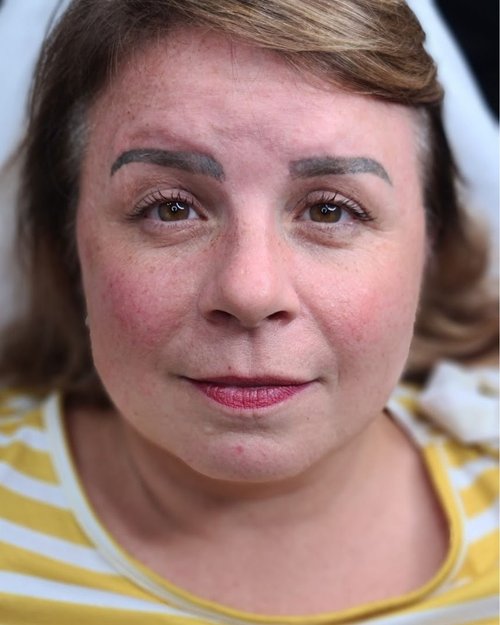

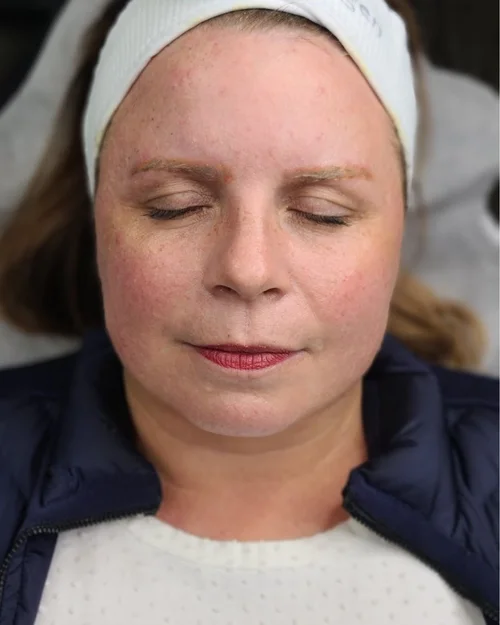
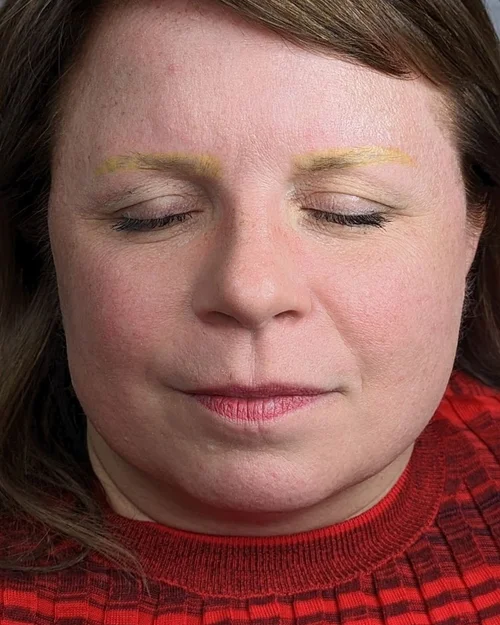
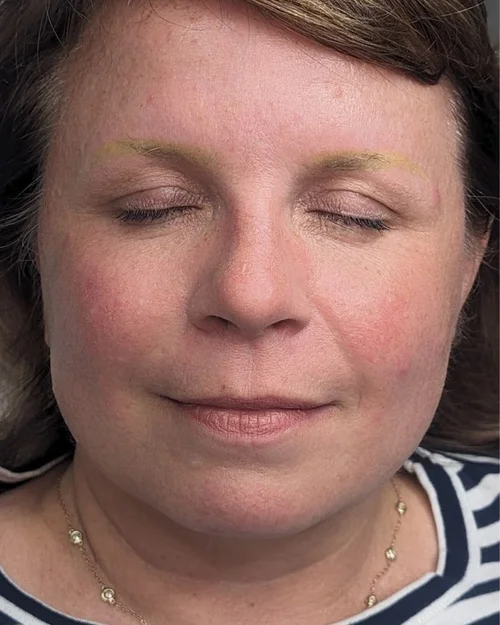
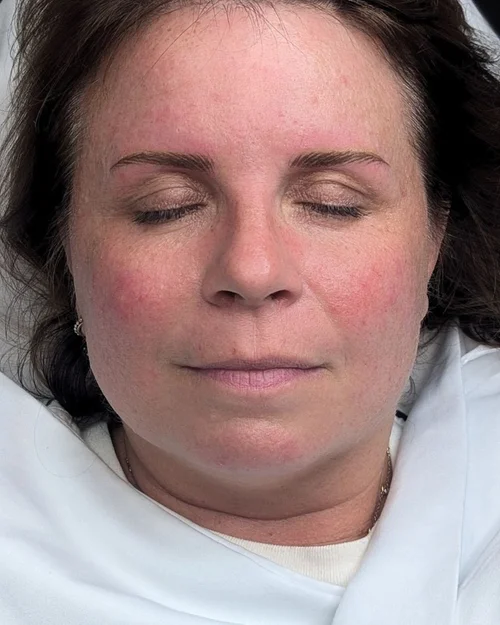
Real correction clients — first session to healed rebuild. Walk through every session of these journeys on our Corrections & Removals page →
Let's talk about the money — plainly
Removal sessions are a flat $450 each — saline or laser, same price — so the method we recommend is never a sales decision. Color correction is a one-time $150 fee, and it's only offered alongside a brow appointment — we do it as part of your session, never as a separate sale. The full rebuild — your new brows, initial session plus the 4–6 week touch-up — is $1,550. No per-zone surcharges. No surprise fees. Afterpay available. Your estimate, stated plainly, at your consult. Shop around NYC and you'll see removal quoted anywhere from $300 to $600 a session — our flat $450 sits right in the middle of that range, for a session that includes what most of those quotes leave out: the medical-office setting, physician oversight on every laser session, the patch tests, and one artist thinking about your whole journey — removal, correction, and rebuild as a single plan.
And yes — correction costs more than getting it right the first time would have. Everyone in the chair knows that better than anyone.
Done right, once, it's over. Done cheap, twice, it never is.
"I can't say enough amazing things about Le Kitsuné. Renee fixed work that I thought was unfixable. I have been going there for years now because of that first correction."
— Aisha S. · Le Kitsuné ClientFrequently Asked Questions
Can badly done microblading be removed completely?
I just got microblading and I hate it — what should I do right now?
How many sessions does it take to remove eyebrow microblading?
Will my natural eyebrow hairs grow back after removal?
What's the difference between saline and laser removal for eyebrows?
Why did my brows turn pink or orange during laser removal?
I already had laser or saline somewhere else and it didn't work — can you still help?
Do I need full removal before I can get new brows?
Will I be without eyebrows during the removal process?
Does removal hurt more than getting the brows did?
Will removal leave a scar or shadow?
How soon after removal can I get my new brows?
How soon after getting microblading can I start removal?
Do microblading removal creams or at-home kits work?
These are the questions about removal and correction. Our full FAQ covers techniques, pricing, healing, skin types, candidacy, and more.
References
- Kirby W, Desai A, Desai T, et al. The Kirby-Desai Scale: A Proposed Scale to Assess Tattoo-removal Treatments. J Clin Aesthet Dermatol. 2009. PubMed
- Ho SG, Goh CL. Laser Tattoo Removal: A Clinical Update. J Cutan Aesthet Surg. 2015. PMC
- Bernstein EF, et al. Optimizing Outcomes of Laser Tattoo Removal (test-spot protocol for cosmetic tattoos). Skin Therapy Letter. Skin Therapy Letter
- Skin-toned tattoo ink under a 755 nm picosecond laser: darkening as part of the elimination process. Aesthetic Medicine. Mattioli Journals
- Leu FJ, et al. Comparison of Picosecond versus Nanosecond Nd:YAG Lasers for Removal of Cosmetic Tattoos (paradoxical darkening significantly lower with picosecond, P < 0.01). PubMed
- Cosmetic Eyebrow Tattoo Removal Using a QS Ruby Laser: A Case Report (reduced eyebrow hair density as an adverse effect; resolved after seven failed sessions elsewhere). Cureus. 2026. Cureus
- Skin Cell Turnover Rate (28–40 Day Cycle). Westlake Dermatology. Westlake Dermatology
Le Kitsuné: NYC's Specialists in Microblading Removal, Brow Correction & Rebuilds
Le Kitsuné is a luxury permanent makeup studio at 200 W 57th Street in Manhattan specializing in microblading removal, eyebrow tattoo correction, and full brow rebuilds. Master artist Renee has performed over 15,000 procedures across 10+ years — roughly 30% of them corrections of work done at other studios. The studio offers both saline removal and PICO laser removal (under medical supervision) in-house, plus color correction and hybrid nano/powder rebuilds — so every client's removal, redesign, and new brows are guided by one artist in one continuous plan. Removal sessions are $450 (saline or laser); color correction is a one-time $150 fee alongside a brow appointment; the full rebuild is $1,550 including its touch-up. Free video consultations are available, and real session-by-session correction journeys are on our Corrections & Removals page.
Clarity first.
More From The Little Magazine
The full service page: what we fix, how removal works, and session-by-session client journeys.
Deep DiveEvery method and timeline in one place — the reference companion to this journey.
Feeling StuckThe mistakes that make it worse, and how expert correction actually works.
Before You RebuildBone structure, balance, and the collaborative preview behind every shape.
The ScienceThe pigment chemistry behind gray, blue, and orange shifts — and why it happens.
PreventionThe eight most common regrets, why each happens, and how experts prevent them.
HealingEvery healing stage from day one through full settle, with an interactive stage selector.
MaintenanceHow the maintenance cycle keeps rebuilt brows current — so you never do a big removal again.
Our PhilosophyThe conservative method that prevents the problems this article helps you fix.
Before You BookSkin types, medical conditions, and medications that affect removal and rebuild results.